
Few physicians practicing hair restoration today have had the opportunity not only to witness the evolution of modern hair transplantation, but to participate in it. Dr. Paul T. Rose is one of them.
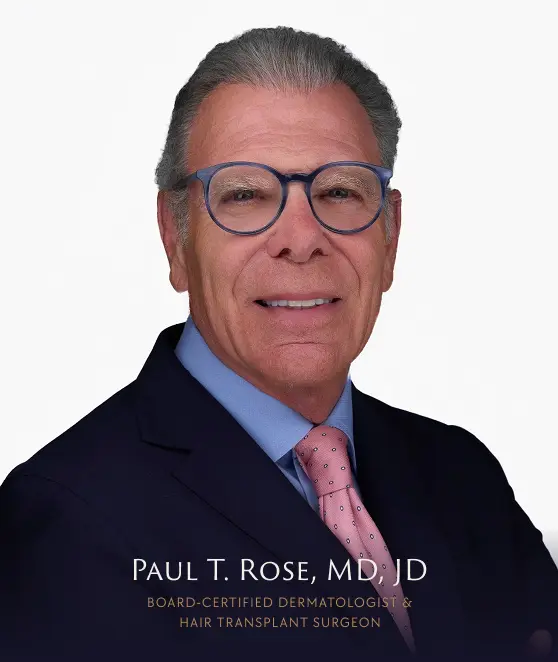
Dr. Rose was among a group of pioneering hair restoration physicians involved in advancing the concepts and techniques of follicular unit transplantation and megasession grafting, developments that helped move hair transplantation toward the natural aesthetic results possible today.
His contributions continued as individual follicular harvesting evolved. Dr. Rose introduced the term Follicular Isolation Technique (FIT) and later participated in published research examining the complex relationship between the visible angle of hair at the scalp surface and the course of follicular structures beneath the skin an issue with important implications for FUE harv.
His scientific interests have extended well beyond surgical technique.
Over the course of his career, Dr. Rose has authored and contributed to peer-reviewed publications and textbook chapters addressing hairline design, follicular unit transplantation, megasessions, FUE/FIT, follicular anatomy, donor harvesting, robotic hair restoration, medical management of hair loss and advances in hair restoration surgery.
His work examining medical treatment alongside transplantation spans more than twodecades, including participation in expert consensus work addressing the role of minoxidil in hair-transplant patients
Dr. Rose’s approach to hair and scalp disorders is grounded in an unusually broad medical and scientific background. He earned his medical degree from Downstate Medical Center in New York City, where he became actively involved in immunology research. His early scientific work included research appointments at the National Institutes of Health (NIH) in immunology and at Good Samaritan Hospital/Johns Hopkins.
After completing an internship in internal medicine at the University of Connecticut, Dr. Rose practiced emergency medicine and became involved in the early development of urgent-care medicine in the United States. He later served as Medical Director of Firstcare Medical Centers in Florida.
He subsequently completed his dermatology residency at Temple University Skin and Cancer Hospital in Philadelphia. Dr. Rose also holds a Juris Doctor (JD) degree, adding a legal education to an already diverse professional background.
Downstate Medical Center, New York City
NIH Immunology Division · Good Samaritan Hospital / Johns Hopkins
Internal Medicine, University of Connecticut
Temple University Skin & Cancer Hospital, Philadelphia
Juris Doctor (JD)
Dermatology
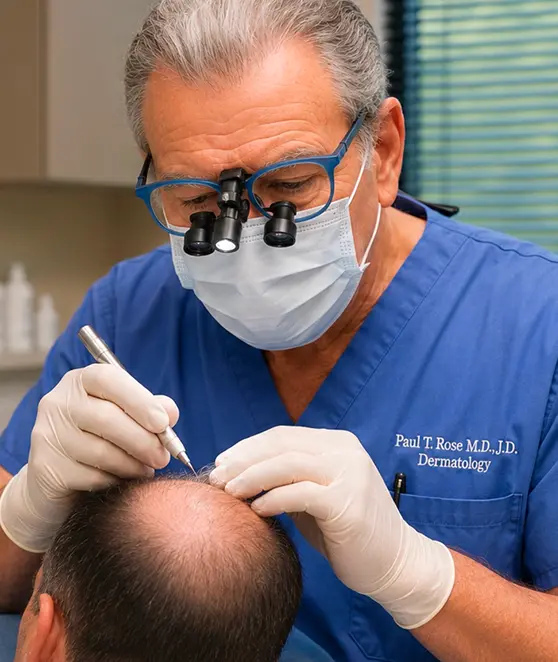
What distinguishes Dr. Rose’s career is not simply its length. It is the breadth of his involvement in the specialty.
He has approached hair restoration from multiple perspectives: as a dermatologist evaluating diseases of the hair and scalp; as a researcher examining follicular biology and anatomy; as a surgeon performing hair transplantation; and as an educator contributing to the medical literature and teaching other physicians.
His career has also placed him alongside many of the physicians involved during the formative years of modern hair restoration, including Dr. William Rassman, Dr. Ron Shapiro and other innovators who helped advance follicular unit transplantation, large-session transplantation and individual follicular harvesting. Today, many of the concepts that emerged during that period are considered routine elements of contemporary hair restoration.
Dr. Rose brings the perspective of someone who was there while the field was changing.
Despite advances in instrumentation and technology, successful hair transplantation cannot be reduced to a device or a graft number. It requires an understanding of hair- loss diagnosis, donor anatomy, follicular-unit selection, hairline design, density distribution, angulation and direction, progressive hair loss and the long-term management of a finite donor supply. It also requires aesthetic judgment. Dr. Rose’s published work on hairline design and the challenges of hair restoration reflects an approach centered on creating results that belong naturally to the individual patient.
Hair transplantation continues to evolve. Techniques will change. Technology will advance. New medical treatments will emerge.
Dr. Rose’s career demonstrates that innovation in hair restoration has never simply been about adopting the newest technology. It has been about understanding the biology, anatomy and aesthetic principles behind the procedure and determining how advances can genuinely improve patient care.
At Golden State Dermatology, patients have the opportunity to consult with a surgeon whose experience extends beyond performing modern hair transplantation.
Dr. Paul T. Rose participated in the evolution that made modern hair restoration possible.